
At the doctor’s in German Beim Arzt – making an appointment, describing symptoms and the phrases you hear during the examination
Going to the doctor in Germany is a challenge for your German: you can easily be caught off guard on the phone when making an appointment and during the examination. Yet the sentences used are almost always the same. If you know thirty or forty phrases, you will get through the appointment comfortably.
Work through this page in order: first the appointment by phone, then reception, then the sentences for your symptoms during the examination, and finally the pharmacy. There are two ways to describe pain, and they work differently; I have given them a section of their own.
1. Making an appointment by phone
| German | Translation |
|---|---|
| Praxis Dr. Meier, guten Tag. | Dr Meier’s surgery, hello. |
| Ich möchte einen Termin vereinbaren. | I would like to make an appointment. |
| Waren Sie schon einmal bei uns? | Have you been to us before? |
| Nein, ich bin neu hier. | No, I am new here. |
| Was haben Sie für Beschwerden? | What are your symptoms? |
| Es ist dringend. | It is urgent. |
| Haben Sie am Montag Zeit? | Are you free on Monday? |
| Geht es auch früher? | Is anything earlier possible? |
| Ich komme um zehn Uhr. | I will come at ten o’clock. |
| Vielen Dank, bis Montag. | Thank you very much, see you on Monday. |
The first sentence at the surgery
At reception you will be asked for your health insurance card. It is called die Versichertenkarte, or simply die Karte.
Ihre Versichertenkarte, bitte. Bitte nehmen Sie im Wartezimmer Platz.
You wait in the waiting room; when it is your turn, you will hear Herr/Frau …, bitte!
2. Two ways to describe pain
This is the only grammar point in the topic. There are two patterns, and they work differently:
Pattern 1: Ich habe …schmerzen (compound noun)
The body part and Schmerzen (pains) join to form one word.
Ich habe Kopfschmerzen. Ich habe Halsschmerzen. Ich habe Bauchschmerzen.
This is the easiest pattern: simple to learn and useful everywhere, rather like English “headache”, “sore throat”, “stomach ache”.
Pattern 2: Mir tut … weh (takes the dative)
The verb wehtun (to hurt) puts the person in the Dativ (dative). So you say mir, not ich.
Mir tut der Kopf weh. Mir tun die Füße weh.
If one part hurts, it is tut; if several hurt, tun. The body part is the subject, so the verb agrees with it.
| Symptom | Translation |
|---|---|
| Ich habe Fieber. | I have a temperature. |
| Ich habe Husten und Schnupfen. | I have a cough and a cold. |
| Mir ist schlecht. | I feel sick. |
| Mir ist schwindelig. | I feel dizzy. |
| Ich fühle mich müde und schwach. | I feel tired and weak. |
| Ich kann nicht schlafen. | I can’t sleep. |
| Ich bin gestürzt. | I fell over. |
| Ich habe mich verletzt. | I hurt myself. |
| Ich bin gegen Pollen allergisch. | I am allergic to pollen. |
| Es tut hier weh. | It hurts here. |
3. What the doctor will ask
Literally “What are you missing?” – don’t be surprised, it is the standard question.
Answer: Seit drei Tagen. (For three days.)
Answer: Ja, gegen Bluthochdruck. (Yes, for high blood pressure.)
You will also hear Atmen Sie tief ein. = Take a deep breath.
Other sentences you will often hear
Haben Sie Allergien? Sind Sie schwanger? Machen Sie den Mund auf.
Ich verschreibe Ihnen ein Medikament. Sie brauchen Ruhe.
At the end of the examination you will hear Gute Besserung! (Get well soon!); you can reply Danke, Ihnen auch einen schönen Tag.
4. Prescriptions and the pharmacy
| Word | Meaning | Note |
|---|---|---|
| das Rezept | prescription | you hand it in at the pharmacy |
| die Krankmeldung | sick note | for your employer |
| die Überweisung | referral | to a specialist |
| der Facharzt | specialist | Hausarzt = GP, family doctor |
| die Apotheke | pharmacy, chemist’s | a Drogerie is NOT a pharmacy |
| die Tablette | tablet, pill | Tropfen = drops |
| die Salbe | ointment, cream | you rub it on |
| die Spritze | injection | Impfung = vaccination |
| die Nebenwirkung | side effect | listed in the package leaflet |
| der Notdienst | out-of-hours service | at night and on public holidays |
At the pharmacy
Ich habe ein Rezept. Wie oft soll ich das nehmen?
Dreimal täglich, nach dem Essen.
For medicine without a prescription: Haben Sie etwas gegen Halsschmerzen? (Do you have anything for a sore throat?)
🩺 Picture vocabulary: at the doctor’s and the pharmacy
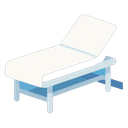 die Praxisdie Praxendoctor’s surgery
 die Apothekedie Apothekenpharmacy, chemist’s
 das Rezeptdie Rezepteprescription
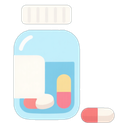 das Medikamentdie Medikamentemedicine
Common pitfalls
1. Don’t build the phrase word for word
English says “I have a headache”, and German works the same way, with one compound noun; “pain in my head” sounds very odd.
❌ Ich habe Schmerzen in meinem Kopf. → ✅ Ich habe Kopfschmerzen.
The natural options are the compound noun or Mir tut der Kopf weh.
2. wehtun puts the person in the dative
❌ Ich tue der Kopf weh. → ✅ Mir tut der Kopf weh.
The part that hurts is the subject, as in English “my head hurts”; the person who is in pain goes in the dative.
3. Apotheke and Drogerie are different places
The Apotheke is the pharmacy, which sells medicines. A Drogerie (dm, Rossmann) sells cosmetics and toiletries, but no medicines.
Don’t be misled by the American word “drugstore”: looking for painkillers in a Drogerie is pointless.
4. Turning up without an appointment
In Germany most practices will not see you without an appointment. In an emergency, go to the Notaufnahme (A&E) or call 116 117; if a life is in danger, call 112.
Saving these two numbers in your phone is more useful than any phrase you could learn.
Test yourself
Fill in the gaps in your head, then open the answer.
Ich möchte einen Termin ___ . · ___ tut der Rücken weh. · Ich habe ___ (headache). · Mir ___ die Füße weh.
vereinbaren (einen Termin vereinbaren = to make an appointment; machen is also accepted) · Mir (wehtun → dative) · Kopfschmerzen (compound noun) · tun (Füße is plural, so the verb is plural too)
Writing tut in the last one is a very common mistake; if the part that hurts is plural, the verb is plural too.
Keep learning
💬 All the phrases you need to make an appointment by phone: Phone calls (in Turkish) →
Practise talking to the doctor now
💬 For people working in hospitals: German for nurses: care vocabulary, talking to patients, shift handover (in Turkish) →
💬 After the doctor’s: At the pharmacy: prescriptions and symptoms (in Turkish) →
💬 To describe an illness: Illnesses in German: Erkältung, Grippe, Fieber →
💬 beim Arzt or zum Arzt? The preposition bei: beim Arzt, bei meinen Eltern → · The preposition zu: zum or zur →
CONTINUE HERE
From the doctor’s side