
Transport in German Die Verkehrsmittel – vehicles with articles and plurals, travel words, the mit dem Bus rule and verbs for getting around
The German word for means of transport is die Verkehrsmittel. The most common ones are das Auto (car), der Bus (bus), der Zug (train), die U-Bahn (underground), das Fahrrad (bicycle) and das Flugzeug (plane). To say how you travel, use mit + Dativ (dative): mit dem Bus (by bus), mit der U-Bahn (by underground).
First come the vehicles with their articles and plurals, then words for stations, tickets and travelling. After that you will find verbs and everyday phrases with example sentences. Click a German word to hear how it is pronounced.
Vehicles (Verkehrsmittel)
mit + dative: how do you travel?
mit dem Auto · mit dem Bus · mit der U-Bahn · mit dem Fahrrad
To say how you travel, use mit + Dativ (dative): masculine and neuter dem, feminine der. Going on foot is zu Fuß. More on this: accusative or dative.
Stations, tickets and travel words
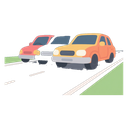 der Staudie Staustraffic jam
Verbs for getting around
| Verb | Meaning | Example | Translation |
|---|---|---|---|
| fahren | to go (by vehicle), to drive | Ich fahre mit dem Bus zur Arbeit. | I go to work by bus. |
| fliegen | to fly | Wir fliegen nach Istanbul. | We're flying to Istanbul. |
| nehmen | to take (a bus, train …) | Ich nehme die U-Bahn. | I'm taking the underground. |
| einsteigen | to get on, to get in | Bitte schnell einsteigen! | Please get on quickly! |
| aussteigen | to get off, to get out | Ich steige am Bahnhof aus. | I'm getting off at the station. |
| umsteigen | to change (trains, buses) | In Köln müssen Sie umsteigen. | You have to change in Cologne. |
| abfahren | to leave, to depart | Der Zug fährt um acht Uhr ab. | The train leaves at eight o'clock. |
| ankommen | to arrive | Wann kommen wir in Berlin an? | When do we arrive in Berlin? |
| zu Fuß gehen | to walk, to go on foot | Ich gehe zu Fuß zur Schule. | I walk to school. |
fahren and fliegen take sein in the Perfekt
Ich bin mit dem Zug gefahren. · Wir sind nach Antalya geflogen.
They describe movement from one place to another, so their Perfekt (present perfect) is formed with sein. The Perfekt forms of the verbs: Perfekt verb list (in Turkish).
einsteigen, umsteigen: separable verbs
Ich steige in Köln um. · Wo muss ich aussteigen?
When the verb is conjugated, the prefix (ein-, aus-, um-, ab-, an-) goes to the end of the sentence.
Useful sentences for travelling
| Example sentence | Translation |
|---|---|
| Wie kommst du zur Arbeit? Mit dem Bus. | How do you get to work? By bus. |
| Wo ist die nächste Haltestelle? | Where is the nearest stop? |
| Wann fährt der nächste Zug nach München? | When does the next train to Munich leave? |
| Eine Fahrkarte nach Berlin, bitte. | A ticket to Berlin, please. |
| Von welchem Gleis fährt der Zug ab? | Which platform does the train leave from? |
| Der Zug hat zehn Minuten Verspätung. | The train is ten minutes late. |
| Ich stehe im Stau. | I'm stuck in a traffic jam. |
Test yourself
Fill in the gap: Ich fahre mit ____ Bus. (der)
dem. mit takes the dative: mit dem Bus.
Fill in the gap: Ich fahre mit ____ U-Bahn. (die)
der. In the dative, the feminine article becomes der.
Which article? ____ Flugzeug
das. Plural: die Flugzeuge.
What is the German for a bus “stop”?
die Haltestelle. Plural: die Haltestellen.
Put into the Perfekt: Wir fliegen nach Izmir.
Wir sind nach Izmir geflogen. Movement: sein.
Frequently asked questions
What are the German words for means of transport?
The most common words are das Auto (car), der Bus (bus), der Zug (train), die U-Bahn (underground), die Straßenbahn (tram), das Taxi (taxi), das Fahrrad (bicycle), das Motorrad (motorbike), das Flugzeug (plane) and das Schiff (ship).
How do you say “I go by bus” in German?
“I go by bus” is Ich fahre mit dem Bus in German. Means of transport follow mit + dative: mit dem Zug, mit der U-Bahn, mit dem Auto.
Which preposition is used with means of transport?
German uses mit, followed by the dative: mit dem Auto, mit der Straßenbahn. To go on foot is zu Fuß.
What is the German for a bus “stop”?
A stop is die Haltestelle in German. A railway station is der Bahnhof, and an airport is der Flughafen.
Keep learning
💬 Cars and driving: Car parts and driving vocabulary →
💬 When you travel: Buying tickets: train, bus, taxi (in Turkish) → · At the airport: check-in and passport control (in Turkish) →
💬 Travelling by vehicle: The preposition mit: mit dem Bus, mit mir →