
German verb conjugation tables Present-tense endings, regular and irregular verbs, sein, haben, werden, modal verbs and separable verbs
In German, you conjugate a verb by adding an ending for each person to the stem: ich lerne, du lernst, er lernt, wir lernen. These endings are the same for all verbs. With irregular verbs, the vowel in the stem also changes in the du and er / sie / es forms: fahren → du fährst. With modal verbs, the ich and er forms are the same: ich kann, er kann.
The tables show first the present-tense endings that apply to all verbs, then regular verbs, the three most common auxiliary verbs (sein, haben, werden), irregular verbs with a stem vowel change, modal verbs and separable verbs. Links to the past and future tenses are at the end of the page.
Present-tense endings: the same for all verbs
| Person | Ending | machen | lernen | heißen |
|---|---|---|---|---|
| ich | -e | mache | lerne | heiße |
| du | -st | machst | lernst | heißt |
| er / sie / es | -t | macht | lernt | heißt |
| wir | -en | machen | lernen | heißen |
| ihr | -t | macht | lernt | heißt |
| sie / Sie | -en | machen | lernen | heißen |
Find the stem, add the ending
lernen → lern- → ich lerne · du lernst · er lernt
Take -en (or -n) off the infinitive and you have the stem. The wir and sie / Sie forms are almost always the same as the infinitive; the exception is sein: wir sind, sie sind.
Two pronunciation rules
du arbeitest · er arbeitet · du tanzt · du heißt
If the stem ends in -t or -d, an -e- is inserted: arbeiten, finden, warten. If the stem ends in -s, -ß, -z, the du form only adds -t: tanzen, heißen, sitzen.
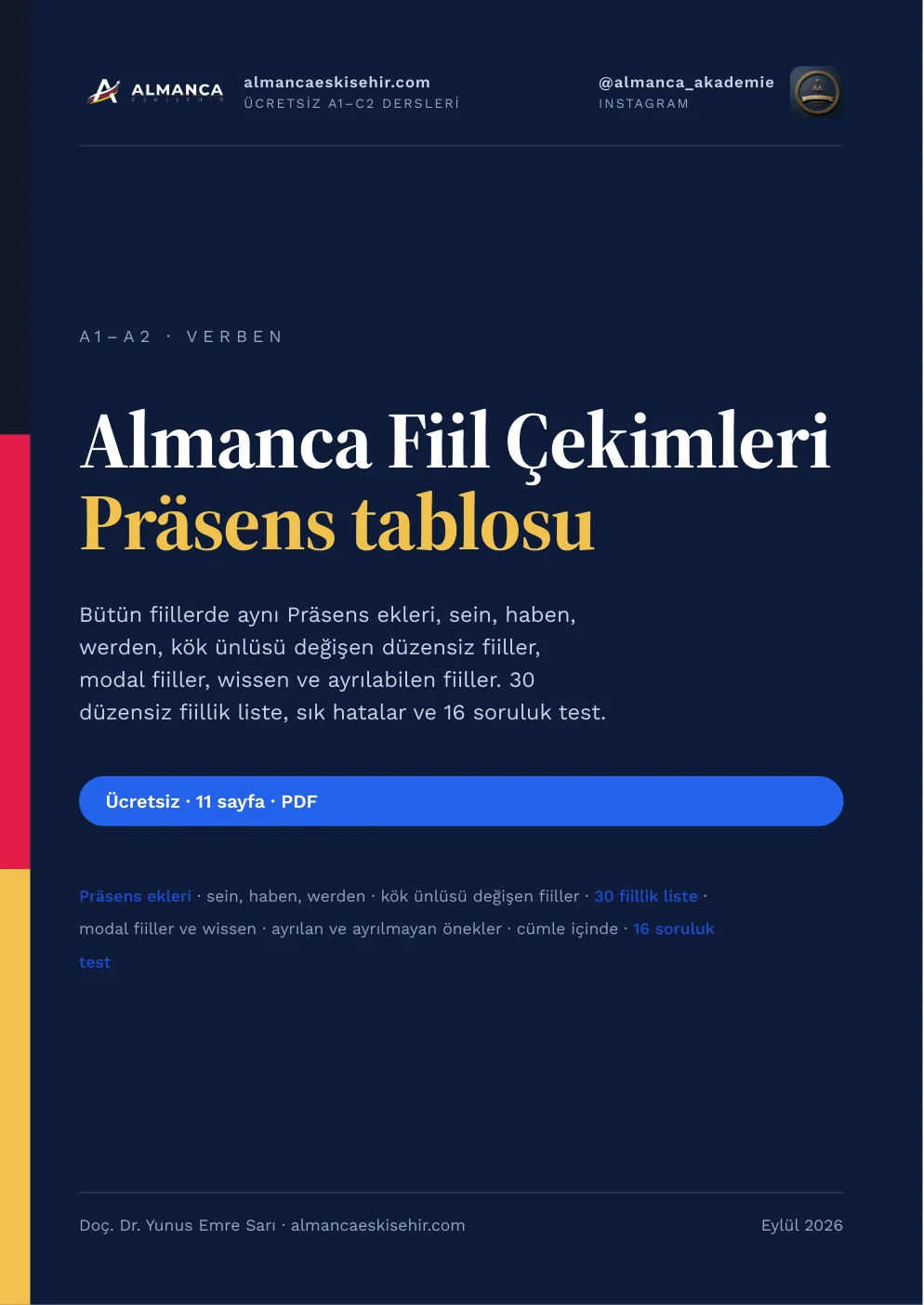
German verb conjugation tables – PDF (in Turkish)
11 pages: the present-tense endings for all verbs, sein, haben, werden, irregular verbs with a stem vowel change, modal verbs, wissen and separable verbs. Plus a list of 30 irregular verbs, common mistakes and a 16-question test. Each section ends with a link to the matching lesson and exercise. The explanations are in Turkish.
Download the PDF → PDF · A4 · no email address neededsein, haben, werden
The three most common verbs are completely irregular and have to be learnt by heart. They are also used to form the Perfekt and the Futur.
| Person | sein (to be) | haben (to have) | werden (to become; future) |
|---|---|---|---|
| ich | bin | habe | werde |
| du | bist | hast | wirst |
| er / sie / es | ist | hat | wird |
| wir | sind | haben | werden |
| ihr | seid | habt | werdet |
| sie / Sie | sind | haben | werden |
More details and examples: sein and haben · Futur I with werden.
Irregular verbs: stem vowel changes
Some verbs (starke Verben, strong verbs) change the stem vowel only in the du and er / sie / es forms. There are four patterns: e → i (geben → gibt), e → ie (lesen → liest), a → ä (fahren → fährt), au → äu (laufen → läuft).
| Person | lesen (e→ie) | sehen (e→ie) | essen (e→i) | geben (e→i) | brechen (e→i) |
|---|---|---|---|---|---|
| ich | lese | sehe | esse | gebe | breche |
| du | liest | siehst | isst | gibst | brichst |
| er / sie / es | liest | sieht | isst | gibt | bricht |
| wir | lesen | sehen | essen | geben | brechen |
| ihr | lest | seht | esst | gebt | brecht |
| sie / Sie | lesen | sehen | essen | geben | brechen |
| Person | fahren (a→ä) | schlafen (a→ä) | tragen (a→ä) | laufen (au→äu) | sprechen (e→i) |
|---|---|---|---|---|---|
| ich | fahre | schlafe | trage | laufe | spreche |
| du | fährst | schläfst | trägst | läufst | sprichst |
| er / sie / es | fährt | schläft | trägt | läuft | spricht |
| wir | fahren | schlafen | tragen | laufen | sprechen |
| ihr | fahrt | schlaft | tragt | lauft | sprecht |
| sie / Sie | fahren | schlafen | tragen | laufen | sprechen |
The change only happens with du and er / sie / es
ich fahre · du fährst · er fährt · wir fahren · ihr fahrt
The stem does not change in the ich, wir, ihr and sie / Sie forms. The Präteritum and Perfekt forms of these verbs are irregular too: list of irregular verbs.
Modal verbs
With modal verbs, the ich and er / sie / es forms are the same and have no ending. The main verb goes to the end of the sentence in the infinitive: Ich kann gut schwimmen.
| Person | können | müssen | wollen | dürfen |
|---|---|---|---|---|
| ich | kann | muss | will | darf |
| du | kannst | musst | willst | darfst |
| er / sie / es | kann | muss | will | darf |
| wir | können | müssen | wollen | dürfen |
| ihr | könnt | müsst | wollt | dürft |
| sie / Sie | können | müssen | wollen | dürfen |
| Person | sollen | mögen | möchten |
|---|---|---|---|
| ich | soll | mag | möchte |
| du | sollst | magst | möchtest |
| er / sie / es | soll | mag | möchte |
| wir | sollen | mögen | möchten |
| ihr | sollt | mögt | möchtet |
| sie / Sie | sollen | mögen | möchten |
Meanings and uses: modal verbs: forms and meanings · conjugation of möchten.
Separable verbs
With separable verbs (auf-, ein-, an-, mit-, fern- …), the conjugated stem stays in second position and the prefix goes to the end of the sentence.
| Person | aufstehen (to get up) | einkaufen (to go shopping) | anrufen (to phone) |
|---|---|---|---|
| ich | stehe … auf | kaufe … ein | rufe … an |
| du | stehst … auf | kaufst … ein | rufst … an |
| er / sie / es | steht … auf | kauft … ein | ruft … an |
| wir | stehen … auf | kaufen … ein | rufen … an |
| ihr | steht … auf | kauft … ein | ruft … an |
| sie / Sie | stehen … auf | kaufen … ein | rufen … an |
The prefix goes to the end
Ich stehe jeden Tag um sieben Uhr auf. · Rufst du mich morgen an?
I get up at seven every day. Will you phone me tomorrow? To practise: separable verbs game.
In context
| Example sentence | Meaning |
|---|---|
| Anna liest ein Buch. | Anna is reading a book. (lesen → liest) |
| Wohin fährst du in den Urlaub? | Where are you going on holiday? (fahren → fährst) |
| Mein Vater schläft bis acht Uhr. | My father sleeps until eight o'clock. (schlafen → schläft) |
| Ich mag keinen Kaffee, aber sie mag ihn. | I don't like coffee, but she does. (mögen: mag / mag) |
| Er gibt mir ein Geschenk. | He is giving me a present. (geben → gibt) |
| Was siehst du da? | What can you see there? (sehen → siehst) |
| Wir arbeiten heute zu Hause. | We are working from home today. |
Common mistakes
1. Changing the stem vowel in the plural too
❌ Wir fähren nach Berlin. → ✅ Wir fahren nach Berlin.
2. Adding -t to the er form of a modal verb
❌ Er kannt gut kochen. → ✅ Er kann gut kochen.
3. Leaving out the e after a stem ending in -t
❌ Du arbeitst viel. → ✅ Du arbeitest viel.
Test yourself
Conjugate: du + fahren
du fährst. a → ä, only in the du and er forms.
Conjugate: er + lesen
er liest. e → ie.
Conjugate: ihr + sein
ihr seid. sein is completely irregular.
Conjugate: sie (she) + können
sie kann. With modal verbs, ich and er / sie / es are the same.
Conjugate: du + warten
du wartest. The stem ends in -t, so an e is inserted.
Make a sentence: ich + aufstehen + um sechs Uhr
Ich stehe um sechs Uhr auf. The prefix goes to the end.
Frequently asked questions
How do you conjugate German verbs?
Take -en or -n off the infinitive and add the ending for each person to the stem: ich -e, du -st, er/sie/es -t, wir -en, ihr -t, sie/Sie -en. Example: lernen → ich lerne, du lernst, er lernt, wir lernen, ihr lernt, sie lernen.
How are irregular verbs conjugated?
Irregular verbs take the same endings, but the stem vowel changes in the du and er/sie/es forms: e → i (geben → gibt), e → ie (lesen → liest), a → ä (fahren → fährt), au → äu (laufen → läuft). The stem stays the same for the other persons.
How is sein conjugated?
sein is completely irregular: ich bin, du bist, er/sie/es ist, wir sind, ihr seid, sie/Sie sind.
How are modal verbs conjugated?
With modal verbs, the ich and er/sie/es forms are the same and take no ending: ich kann, er kann; ich muss, er muss. The plural uses the infinitive form: wir können, sie müssen. The main verb goes to the end of the sentence in the infinitive.
Keep learning
Practise the present tense (Präsens) now
💬 The past forms of regular verbs, level by level: List of regular verbs (409 verbs, PDF, in Turkish) →
💬 What comes before and after conjugation? How to learn German: from the order of topics to a study plan (in Turkish) →
💬 Conjugation tables for individual verbs (in Turkish): gehen → · fahren → · kommen → · essen → · trinken → · sprechen → · lesen → · sehen → · geben → · nehmen → · schlafen → · laufen → · finden → · helfen → · wissen → · werden → · machen → · arbeiten → · heißen → · wohnen → · spielen → · lernen → · müssen → · können → · dürfen → · wollen → · sollen → · mögen →
🎮 Practise the Präsens, Präteritum and Perfekt forms of irregular verbs with a game: Play the irregular verbs game →