
🔊 Click the German words and example sentences with a dotted underline to hear the pronunciation.
Wechselpräpositionen (two-way prepositions)
Some German prepositions take either the Akkusativ or the Dativ, depending on the situation the verb describes. They are called Wechselpräpositionen (two-way prepositions), and the choice depends on whether the sentence expresses movement or position.
Video explanation (in Turkish)
This video explains the basic idea of the topic. The explanation is in Turkish.
🧭 All German prepositions in one list: German prepositions: 44 prepositions in four case groups →
Definition
Wechselpräpositionen sind neun lokale Präpositionen, die je nach Bedeutung den Akkusativ oder den Dativ regieren. Bei einer Richtungsangabe (wohin?) folgt der Akkusativ, bei einer Ortsangabe (wo?) der Dativ.
Two-way prepositions are nine prepositions of place that can take either the Akkusativ or the Dativ, depending on their meaning. If the sentence expresses a direction (where to?), use the Akkusativ; if it expresses a position (where?), use the Dativ. English sometimes marks the same difference with pairs such as into / in and onto / on.
The basic distinction – Bewegung vs. Position (movement vs. position)
Moving towards a place, reaching a destination, changing position.
(I am putting the book on the table.)
Being in a fixed place without moving.
(The book is lying on the table.)
Decision guide – which case?
Diagram – prepositions with a fixed and a variable case

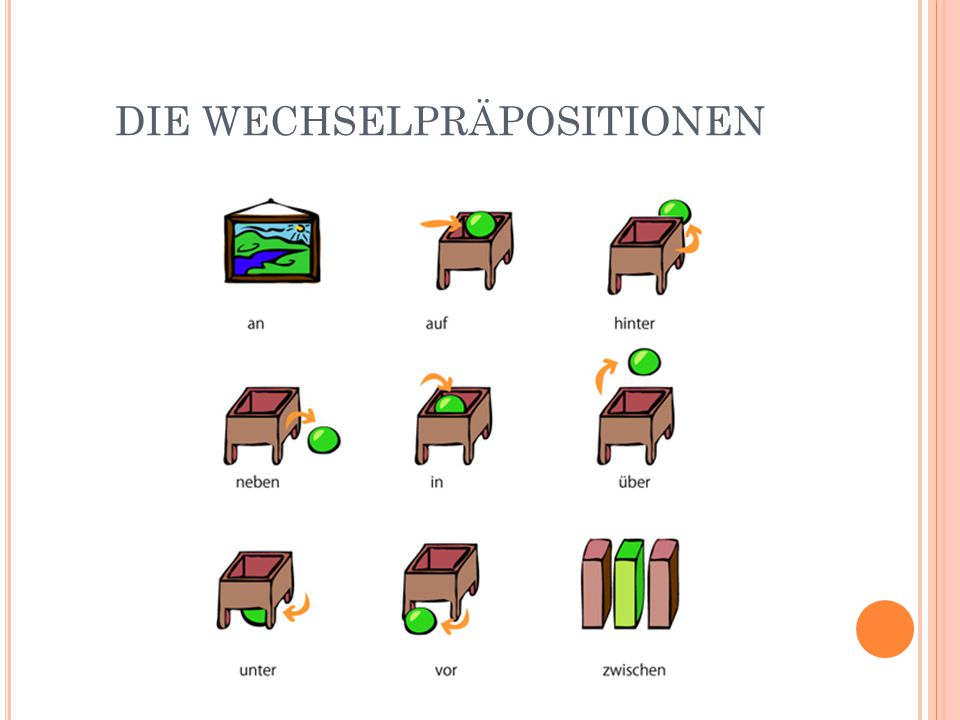
The nine two-way prepositions with examples
Visual summary – Die Wechselpräpositionen
How the articles change – overview
| Nominativ | Akkusativ (wohin?) | Dativ (wo?) |
|---|---|---|
| der (m) | den | dem |
| die (f) | die | der |
| das (n) | das | dem |
| die (Pl.) | die | den …(n) |
In the Dativ plural, the noun usually takes the ending -n: den Büchern, den Kindern.
Contractions of preposition and article

Verb pairs – movement / position
Five verb pairs that are often used with two-way prepositions form the backbone of the movement–position distinction. The verbs on the left take the Akkusativ, the verbs on the right the Dativ.
| Akkusativ (wohin?) | Dativ (wo?) |
|---|---|
| legen — to lay, put (flat) | liegen — to lie, be (lying flat) |
| stellen — to stand, put (upright) | stehen — to stand, be (upright) |
| setzen — to sit (someone) down | sitzen — to sit, be sitting |
| hängen (weak) — to hang (something) up | hängen (strong) — to be hanging |
| stecken — to put (something) into | stecken — to be (stuck) in |
Kontraktion – contracted forms
In spoken German, other contractions are also used, such as auf das → aufs, vor das → vors, hinter das → hinters; am, ans, im, ins, however, are standard in written German too.
Video with examples (in Turkish)
A second video with more examples. The explanation is in Turkish.
Additional presentation
Wechselpräpositionen – slides
An external presentation for anyone who would like to follow the topic on slides.
Mein neues Zimmer – My new room
Fill in the gaps in the text with a suitable preposition. Pay attention to whether the verb expresses direction or position.
Mein Klavier stelle ich (3) das Fenster. (4) dem Klavier hängt jetzt ein altes Familienbild (5) der Wand. Eine kleine Pflanze steht (6) dem Klavier.
Mein Schreibtisch steht (7) dem Fenster und dem Bett. Den Mülleimer stelle ich (8) den Schreibtisch.
Das Sofa stelle ich gleich (9) die Tür. (10) das Sofa lege ich viele bunte Kissen. (11) dem Sofa schläft jetzt meine Katze.
Mein Zimmer ist endlich fertig.
Lösungsschlüssel – answer key
- In meinem Zimmer ist viel Platz. Dativ — wo?
- Ich trage neue Möbel in den Raum. Akkusativ — wohin?
- Mein Klavier stelle ich vor das Fenster. Akkusativ — wohin?
- Über dem Klavier hängt ein Familienbild. Dativ — wo?
- … an der Wand. Dativ — wo?
- Eine Pflanze steht auf dem Klavier. Dativ — wo?
- Mein Schreibtisch steht zwischen dem Fenster und dem Bett. Dativ — wo?
- Den Mülleimer stelle ich neben / hinter / unter den Schreibtisch. Akkusativ — wohin?
- Das Sofa stelle ich an / neben / vor die Tür. Akkusativ — wohin?
- Auf das Sofa lege ich viele Kissen. Akkusativ — wohin?
- Auf dem Sofa schläft meine Katze. Dativ — wo?
Make sentences with the Akkusativ
Use the words to make sentences with the Akkusativ. All the verbs express movement or direction.
legen – ich – das Heft – auf – der Tischsetzen – die Mutter – das Kind – neben – der Sesselhängen – er – der Mantel – in – der Schrankstellen – sie – der Ball – an – die Eckestellen – der Vater – das Auto – vor – die Türlegen – wir – der Teppich – unter – der Tischhängen – der Opa – das Bild – an – die Wandsich setzen – ich – zwischen – Eren und Hanssich legen – der Papa – auf – das Sofagehen – der Lehrer – an – der Tisch
Lösungsschlüssel – answer key
- Ich lege das Heft auf den Tisch. Akkusativ
- Die Mutter setzt das Kind neben den Sessel. Akkusativ
- Er hängt den Mantel in den Schrank. Akkusativ
- Sie stellt den Ball an die Ecke. Akkusativ
- Der Vater stellt das Auto vor die Tür. Akkusativ
- Wir legen den Teppich unter den Tisch. Akkusativ
- Der Opa hängt das Bild an die Wand. Akkusativ
- Ich setze mich zwischen Eren und Hans. Akkusativ
- Der Papa legt sich auf das Sofa. Akkusativ
- Der Lehrer geht an den Tisch. Akkusativ
Make sentences with the Dativ
Use the words to make sentences with the Dativ. All the verbs express position or a state.
liegen – das Heft – auf – der Tischsitzen – das Kind – neben – der Sesselhängen – der Mantel – in – der Schrankstehen – der Ball – an – die Eckestehen – das Auto – vor – die Türliegen – der Teppich – unter – der Tischhängen – das Bild – an – die Wandsitzen – ich – zwischen – Eren und Hansliegen – der Papa – auf – das Sofastehen – der Lehrer – an – der Tisch
Lösungsschlüssel – answer key
- Das Heft liegt auf dem Tisch. Dativ
- Das Kind sitzt neben dem Sessel. Dativ
- Der Mantel hängt im Schrank. Dativ
- Der Ball steht an der Ecke. Dativ
- Das Auto steht vor der Tür. Dativ
- Der Teppich liegt unter dem Tisch. Dativ
- Das Bild hängt an der Wand. Dativ
- Ich sitze zwischen Eren und Hans. Dativ
- Der Papa liegt auf dem Sofa. Dativ
- Der Lehrer steht am Tisch. Dativ
A final word – a closer look
Locative and directional use
Academic grammars of German describe two functions of the two-way prepositions: in locative use (expressing position) they take the Dativ, in directional use (expressing direction) the Akkusativ. This distinction does not rest only on the question (wo? / wohin?) but on the type of action the verb expresses.
In locative use, the position describes a relationship that holds for the whole event; in directional use, the position is a relationship that only comes about when the action is completed. In other words, the Dativ marks an ‘existing’ position, the Akkusativ a ‘resulting’ one.
Related topics
💬 Which preposition for cities, countries, people and home? wo, wohin, woher: the difference and the right prepositions →
💬 The two-way prepositions one by one (in Turkish): an, auf or in? an der Wand, auf dem Tisch → · über: über das Wetter, über 18 → · unter: unter dem Tisch, unter Freunden → · vor: vor zwei Jahren, Angst vor → · zwischen, neben, hinter: between, next to, behind →