
📘 What is the Akkusativ and how do the articles change? The Akkusativ: article table, explanation and exercises →
German verbs with the Akkusativ (verbs with a direct object)
In German, transitive verbs take their direct object in the Akkusativ. Learn these verbs – whose object answers ‘Wen?’ (whom?) or ‘Was?’ (what?) – with examples.
Quick answer
Which German verbs take the Akkusativ?
Most German verbs take their object in the Akkusativ (accusative) – so the list you really need to memorise is the short one of verbs that take the Dativ. The most common Akkusativ verbs: haben, sehen, hören, kaufen, essen, trinken, lesen, schreiben, brauchen, finden, kennen, lieben, besuchen, verstehen, suchen, nehmen.
| verb | example sentence |
|---|---|
| haben | Ich habe einen Bruder. |
| sehen | Ich sehe den Film. |
| brauchen | Ich brauche einen Stift. |
| besuchen | Ich besuche meinen Onkel. |
| verstehen | Ich verstehe die Frage nicht. |
How can you tell whether a verb takes the Akkusativ or the Dativ?
Instead of looking for a rule, ask a question: if Wen? / Was? (whom? / what?) fits, the verb takes the Akkusativ; if Wem? (to whom?) fits, it takes the Dativ.
„Ich sehe wen? – den Mann.“ (Akkusativ) / „Ich helfe wem? – dem Mann.“ (Dativ)
There are only a few verbs that take the Dativ, and they are learnt as a list: helfen, danken, gefallen, gehören, antworten, folgen, passen, schmecken, gratulieren.
Why does the Akkusativ matter? In Ich sehe den Mann. you use den, not der – because ‘Mann’ is the direct object of the verb sehen (to see). In the masculine Akkusativ, der → den and ein → einen; feminine and neuter do not change.
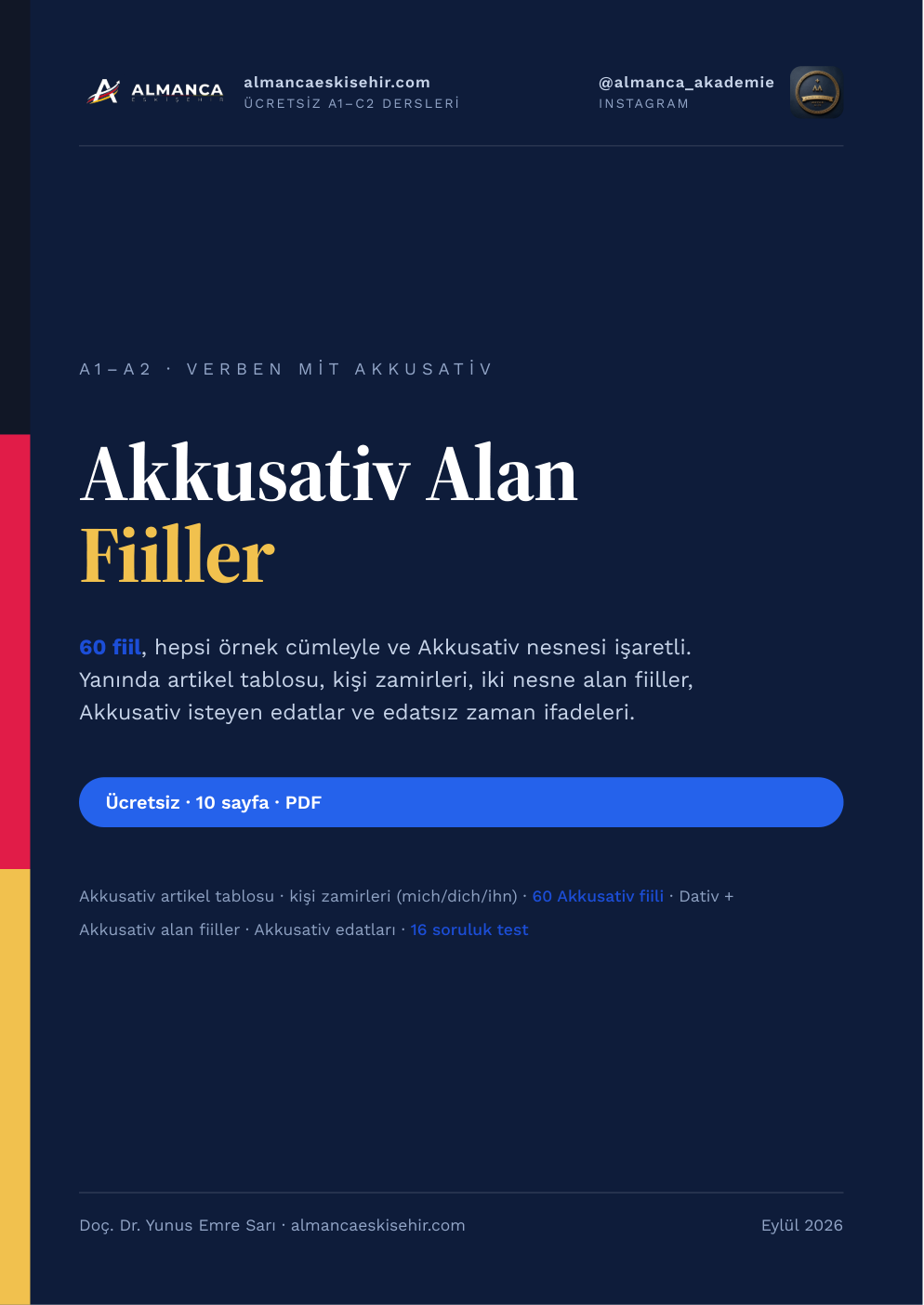
List of verbs with the Akkusativ (PDF, in Turkish)
10 pages. 60 verbs, each with an example sentence and the Akkusativ object marked. Plus an article table, personal pronouns, verbs with two objects, prepositions that take the Akkusativ and time expressions without a preposition. Each section ends with a link to the lesson and exercise on that topic.
Download PDF → PDF · A4 · no email needed25 basic Akkusativ verbs
How the article changes – quick table
| Case | Maskulin | Feminin | Neutrum | Plural |
|---|---|---|---|---|
| Nominativ | der / ein | die / eine | das / ein | die / — |
| Akkusativ | den / einen | die / eine | das / ein | die / — |
💡 Only the masculine changes: der → den and ein → einen. Everything else stays the same.
Exercises – choose the correct form
-
Ich _____ einen Bruder. (haben)
Answer
habe ich → habe -
Kaufst du _____ Auto? (das / den / ein)
Answer
das Auto neuter · Akk → das (no change) -
Wir suchen _____ Hund. (der / den / ein)
Answer
den Hund masculine · Akk → den -
Sie _____ die Tür. (schließen → er/sie)
Answer
schließt er/sie/es → schließt -
Möchten Sie _____ Kaffee? (ein / einen / eine)
Answer
einen Kaffee masculine · Akk (indefinite) → einen -
Er _____ seinen Lehrer. (fragen → er)
Answer
fragt er/sie/es → fragt -
Ich _____ mein Heft verloren. (haben → ich)
Answer
habe auxiliary verb in the Perfekt: habe … verloren -
Die Mutter _____ ihre Tochter. (rufen → er/sie)
Answer
ruft er/sie/es → ruft -
Wir _____ die neuen Wörter. (wiederholen → wir)
Answer
wiederholen wir → wiederholen (unchanged) -
Er _____ eine Blume. (sehen → er)
Answer
sieht sehen is irregular: er sieht
Quick decision tips
- Ask Wen? / Was? (whom? / what?) – the answer is in the Akkusativ.
- Remember the masculine change der → den, ein → einen.
- Feminine (die/eine) and neuter (das/ein) do not change in the Akkusativ.
- Instead of just memorising the Akkusativ verbs, practise them in sentences.
Related topics
💬 Akkusativ verb = transitive verb: Transitive and intransitive verbs: legen / liegen, haben / sein (in Turkish) →
🎮 Practise the article change after Akkusativ verbs with a game: Nominativ or Akkusativ? Play now →